TRENDEFRARAtlas of the Sultans · Ottoman monuments
Haseki Hürrem Sultan Hamam (Hagia Sophia Hamam)
Monument · Bathhouse, Istanbul, 1553
- Type
- Bathhouse (hammam)
- Built
- 1553
A work of Mimar Sinan
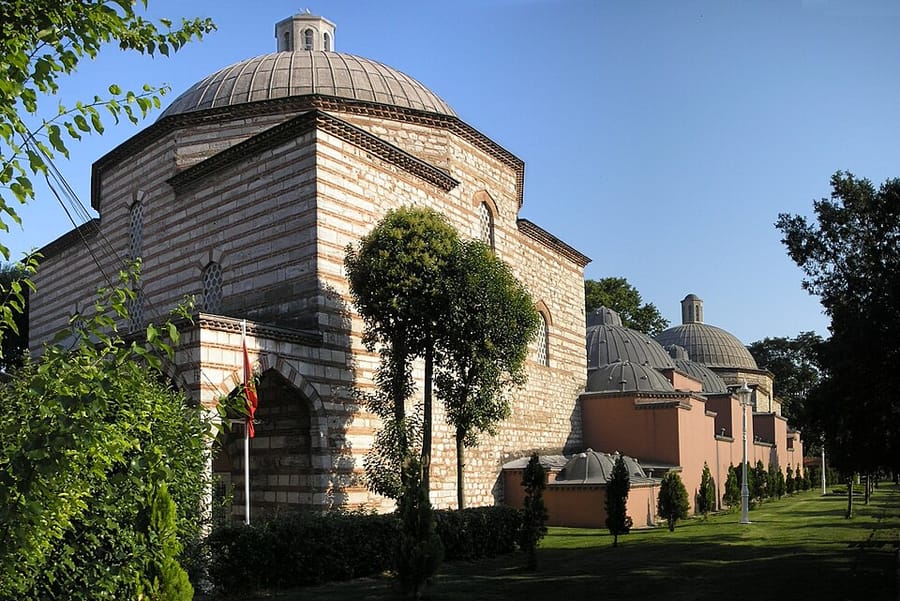

Sinan's double bathhouse for Hürrem Sultan
This double bathhouse stands opposite the Hagia Sophia Mosque, on the edge of Sultanahmet Square, between the Hagia Sophia and the Sultan Ahmed Mosque. According to the date given in figures in the verse inscription over the door of the men's section, it was built in 1553. The inscription calls it “sultanic”, and the lists of Mimar Sinan's works name it the “Haseki Sultan Bathhouse”; it was thus built by Mimar Sinan for Hürrem Sultan, the wife of Suleiman the Magnificent, to provide income for her charitable foundations.
Some 75 metres long, the bathhouse has its men's and women's sections set one behind the other along its length, each with a changing hall, a three-part cool room and a hot room with four iwans. After the 1913 fire destroyed the surrounding quarter the building was neglected; alterations to turn it into a museum were begun in 1916–17, but the plan was never carried out, and in later years it served as a gas and petrol depot, a paper store and for a time a coal store. It was restored by the architect Cahide Tamer in 1957–58, and a new restoration began in 1986.
Inscription and later history
Calculating the date in the verse inscription by a poet using the pen name Hüdayi poses some difficulties, but since the date is also given in numerals, the building is accepted as completed in 1553. Until the Ishak Pasha fire of 1913 the bath stood in the midst of a densely built neighbourhood. The Polish Count E. Raczynski, who came to Istanbul in 1814 and bathed there, described it in his travel account and published its plan in his book printed in 1824.
During preparations to turn it into a museum in 1916–1917, a passage was opened in the wall between the men's and women's sections, and a five-bay portico with six marble columns covering the whole front was added to the men's section; in the 1930s a carpet exhibition was held inside. In the years when it served as a depot, its floor collapsed in places. In the 1957–1958 restoration the lanterns of the large domes were built as closed domelets; in the following restoration open lanterns replaced them. Rented by the Ministry of Culture from the General Directorate of Foundations, the bath housed an exhibition opened in 1988.
Architecture and decoration
The changing room of the men's section, facing Hagia Sophia, is slightly larger than the other and has a higher dome. The two large changing rooms are built in regular bands of stone and brick, the middle parts of roughly dressed stone; the water tank and furnaces run along the side facing the Sea of Marmara. The domes of the changing rooms rest on corner squinches, and the doors to the cool rooms have hoods above them. Mihrab-shaped doors opening off the central area with its heated platform lead to the private cubicles between the iwans.
The arch of the men's door is worked in two-coloured stone and set in a marble frame. Marble benches with shoe compartments beneath them line the changing rooms. The central fountain once had a unique spout in the form of three dolphins jetting water into a lobed marble bowl, possibly brought from the West as war booty. Geometric inlay in coloured marble decorates the heated platform and other places; Semavi Eyice considers the building the most splendid of Sinan's baths.
Related sultans
Cite as: Atlas of the Sultans, “Haseki Hürrem Sultan Hamam (Hagia Sophia Hamam) · Ottoman monuments”, https://padisahlaratlasi.com/en/monuments/haseki-hurrem-sultan-hamam-hagia-sophia-hamam/ (last updated 21 November 2026). Corrections · Image credits