TRENDEFRARAtlas of the Sultans · Ottoman monuments
Fatih Mosque of Kyustendil
Monument · Mosque, Kyustendil, 1530–1531
- Type
- Mosque
- Location
- Bulgaria
- Built
- 1530–1531
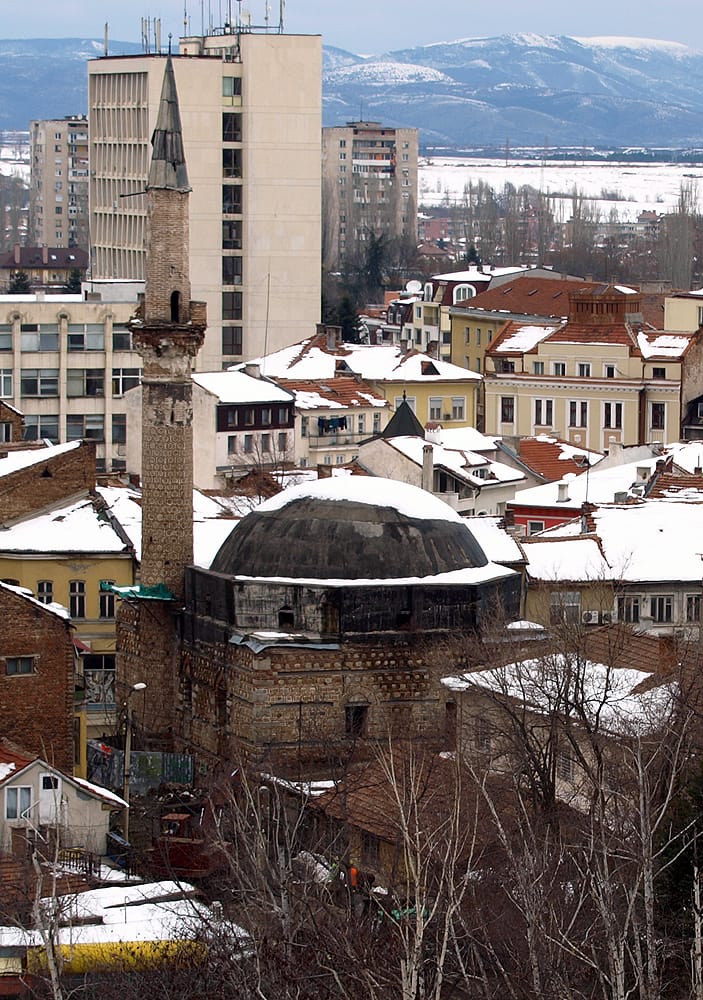

A mosque with a disputed name
This mosque, on a corner where two streets meet in the Bulgarian town of Kyustendil (Köstendil), is known locally as the Fatih Mosque, the name also recorded by H. Minetti, who studied the town's monuments during the First World War. Osman Nuri Peremeci, however, argued that the name is incorrect and that the mosque was built in 1530–31, in the reign of Suleiman the Magnificent; that date appears in brick on the drum of the dome. Its real name and founder are unknown today.
The mosque has no courtyard. Its square prayer hall is covered by a single dome just over 11.5 metres across, resting on a windowed octagonal drum, with rich muqarnas in the transitions. The walls are built in a mixed technique of stone and brick. Its most remarkable feature is the octagonal minaret, whose light hexagonal stones, set in frames probably of brick, form a honeycomb pattern unparalleled in Ottoman architecture. When Semavi Eyice visited in 1966, two bays of the portico had been turned into shops, the prayer hall stood empty and neglected, and the dome had deep cracks. Scaffolding was later reported to have been put up for a restoration, but its outcome is not known.
Portico and dome
The mosque's portico is closed by walls on both sides; its narrower central part of three bays opens outward through three arches resting on two columns. Both the vault of the central bay and the transition to the side domes are formed with very rich muqarnas. In the prayer hall, the transition from the square to the circle of the dome is made by pendentives that begin very low and are filled with muqarnas.
Colourful masonry
In the outer walls two courses of brick were laid between each course of roughly dressed stone, and a vertical pair of bricks was set between every stone, producing a colourful and eye-catching surface. The same mixed technique is found in other buildings in Kyustendil, in Ihtiman near Sofia and in the mosques of Karlıova (Karlovo).
Lost furnishings
The wooden gallery shown on H. Minetti's plan had disappeared, and the lamps seen in his photographs were no longer there in 1966. The wooden minbar had no artistic value; only a few old carpet fragments remained on the floor. As Kyustendil, once entirely Turkish and Muslim, changed in population, the mosque was left to itself. Ayverdi wrote that there was no Fatih Mosque in the town, but he never mentioned the crudely made brick date in the drum of the dome.
Source: TDV Encyclopedia of Islam (TDV İslâm Ansiklopedisi), “FÂTİH CAMİİ” (Semavi Eyice)
Related sultans
Cite as: Atlas of the Sultans, “Fatih Mosque of Kyustendil · Ottoman monuments”, https://padisahlaratlasi.com/en/monuments/fatih-mosque-of-kyustendil/ (last updated 21 November 2026). Corrections · Image credits