TRENDEFRARAtlas of the Sultans · Ottoman monuments
Gülbahar Hatun Mosque
Monument · Mosque, Trabzon, 1505–1506
- Type
- Mosque
- Built
- 1505–1506

The complex of Selim I's mother
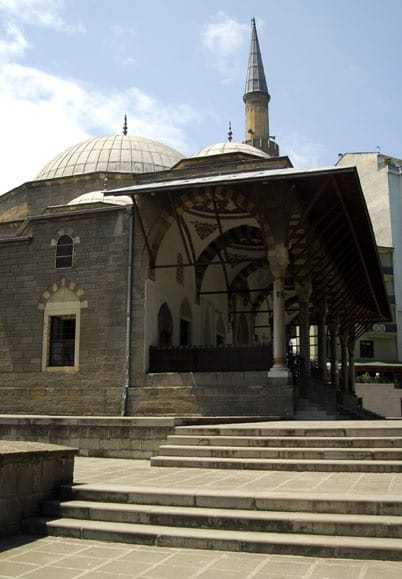
This is the main building of the complex (külliye) founded in Trabzon by Gülbahar Hatun, mother of Sultan Selim I (Yavuz); today only the mosque, the tomb and a renewed ablution fountain survive. The mosque has no inscription, but the inscription of the tomb suggests that it too was built around 1505–1506. Of the type with side rooms (zaviye or tabhane), it has a 12 × 12 metre prayer hall under a dome on a twelve-sided drum, two domed corner rooms and a portico of five domes on six marble columns.
The minaret is built of alternating courses of white and red dressed stone. All the decoration of the mosque was renewed during restorations in the 1970s. East of the mosque stands the octagonal domed tomb, whose window arches are decorated with coloured stone and topped by richly carved medallions. The most important lost building of the complex was the two-storey madrasa, also known as the Sultaniye Madrasa; repaired in 1883, it fell into neglect and was removed after 1927.
Entrances and side rooms
Until recently the mosque gave its name to the district now called Atapark. The portico is covered by five domes and a wide eave; the transition to the central dome above the muqarnas portal is likewise made with muqarnas. On either side of the door are a prayer niche and two windows. Three doors lead into the prayer hall from this façade: the portal opens into the main space and the two corner doors into the side rooms (zawiyas). Paths lead up to the doors, and the floor of the portico, divided in two by the central path, forms a raised platform.
The main space is lit by two windows at the front, one on each side and four in the drum. The two corner zawiyas, measuring 4.50 × 5.45 m, are domed and lit by one window each opening to the sides.
Mihrab, minbar and ablution fountain
The marble mihrab has a crest and is decorated with rumi scrolls; its edges were also painted during the restoration of the 1970s. The minbar, with small friezes, is likewise of marble and modest. The minaret, whose octagonal base adjoins the west wall of the mosque, has a muqarnas balcony. The ablution fountain in the middle of the courtyard was completed on its surviving remains: its pool with an iron grille is covered by a tall tent-shaped cone resting on eight tapering columns, clad in lead like the mosque's entire roofing.
Tomb and madrasa
The slightly pointed, lead-covered dome of the tomb rests on an octagonal drum; there are windows on all its faces except the north. Above the door, which opens to the south-east, are the building inscription and two basmalas set within rumi scrolls. The two-storey madrasa, which has not survived, stood to the north of the mosque.
Related sultans
Cite as: Atlas of the Sultans, “Gülbahar Hatun Mosque · Ottoman monuments”, https://padisahlaratlasi.com/en/monuments/gulbahar-hatun-mosque/ (last updated 21 November 2026). Corrections · Image credits