TRENDEFRARAtlas of the Sultans · Ottoman monuments
Firuz Agha Mosque
Monument · Mosque, Istanbul, 1490–1491
- Type
- Mosque
- Built
- 1490–1491
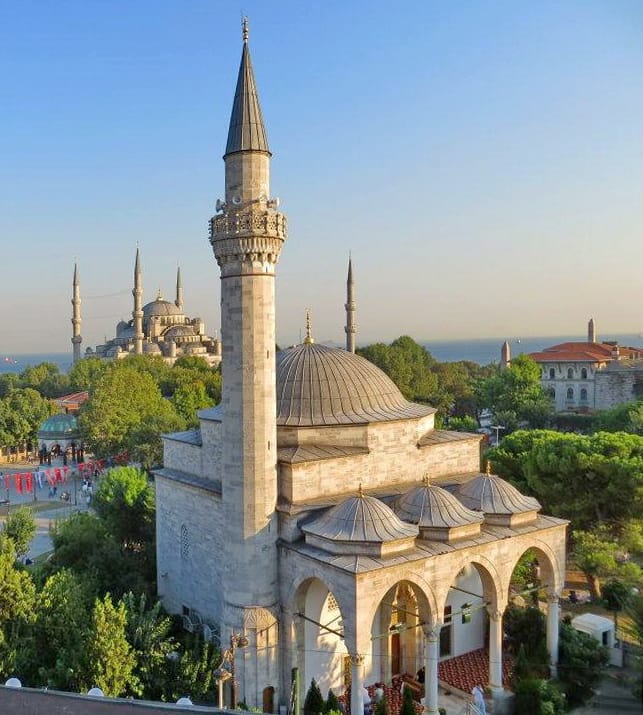

A single-domed mosque on the Divanyolu
Standing in Sultanahmet at the corner where the Hippodrome (Atmeydanı) meets the Divanyolu, the mosque was built in 1490–91, according to the Arabic inscription above its door, by Firuz Agha, chief treasurer of Bayezid II; the inscription is in the hand of the calligrapher Şeyh Hamdullah. Firuz Agha died in 1512–13 and was buried in his tomb in the mosque's graveyard. According to the foundation register of 1546, his endowments included the Binbirdirek Cistern. The mosque also appears in a 16th-century miniature by Matrakçı Nasuh.
The square main space of cut stone is covered by a lead-clad dome on a low twelve-sided drum; in front is a three-domed portico resting on four marble columns. The minaret, damaged in the 1648 earthquake, had its upper shaft renewed in the 17th century. During the Alemdar incident of 1808 the founder's tomb and the primary school fell into ruin, and after the Hocapaşa fire of 1865 the ruined tomb was removed entirely when the Divanyolu was widened. The houses crowding around the mosque were expropriated around 1938, leaving it in open view. Even without its dependencies, it is considered one of the best-known and most beautiful single-domed Ottoman mosques.
Endowments and early depictions
According to the endowment register of 1546, Firuz Agha had a school beside the mosque, a madrasa in Havza and fountains at the fortress of Smederevo and in the town of Saray. For these, many cells and shops around the mosque were endowed; the wooden shops on the street were known as the Firuzağa Market and burned in the Hocapaşa fire of 1865. In 1517 a man named Sufi Hayreddin had a lectern placed in the mosque, and in 1659–60 a man named Mustafa Agha donated 9,000 akçe. The Flemish painter Pieter Coeck van Aelst, who came to Istanbul in the early years of Suleiman the Magnificent, included the mosque in his engraving of the Hippodrome. The survey report on the 1648 earthquake states that the upper section of the minaret had collapsed and needed rebuilding.
Portal and interior
Each facade of the main space has two windows below and two above. The four marble columns of the portico have muqarnas capitals. The entrance, with a flattened arch of two-coloured stone, sits in a magnificent portal niche; above the arch is the inscription in eight cartouches in the hand of Şeyh Hamdullah, and the upper part of the niche holds five rows of muqarnas. In medallions at the bottom of the muqarnas, the name “Muhammad” is worked in square kufic. The plaster mihrab inside and the corner pendentives are also filled with muqarnas. The painted decoration is in classical style but new; the wooden minbar is partly old and the lectern entirely so.
Minaret and lost buildings
The claim that the minaret originally stood on the right and was rebuilt in its present place after the Alemdar Incident is not convincing; the minaret is in its original position. With its thick sixteen-sided shaft rising on a twelve-sided base, it accords with early minaret architecture. In the graveyard, beside Firuz Agha's tomb, there was also the tomb of Ismail Agha, one of the aghas of the Gate of Felicity; no trace of either remains. In the 1938 rearrangement an uninscribed marble sarcophagus was placed to the east of the mosque; it is thought to belong to Firuz Agha. The site of the primary school, where Şeyh Hamdullah is said to have first taught, is unknown, and the sebil adjoining the courtyard wall has not survived.
Source: TDV Encyclopedia of Islam (TDV İslâm Ansiklopedisi), “FÎRUZ AĞA CAMİİ” (Semavi Eyice)
Related sultans
Cite as: Atlas of the Sultans, “Firuz Agha Mosque · Ottoman monuments”, https://padisahlaratlasi.com/en/monuments/firuz-agha-mosque/ (last updated 21 November 2026). Corrections · Image credits