TRENDEFRARAtlas of the Sultans · Ottoman monuments
Büyükçekmece Caravanserai
Monument · Caravanserai, Büyükçekmece, 16th century
- Type
- Inn and caravanserai
- Location
- Turkey
A work of Mimar Sinan
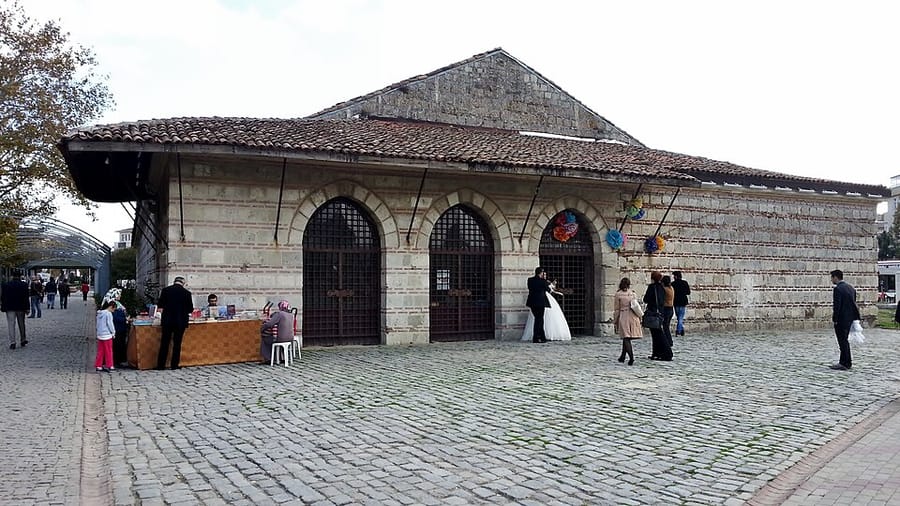

A staging inn on the Rumelian road
Also known as Kurşunlu Han (the Lead-Roofed Inn), the caravanserai was built as one of the staging posts on the main caravan and military road leading from Istanbul to Rumelia. A caravanserai built earlier on the same site by Mehmed the Conqueror (Fatih Sultan Mehmed) is mentioned in the sources, but no trace of it remains. Who built the present building, and when, is not known for certain. Since it appears in the Tuhfetü'l-mimarin and the Tezkiretü'l-ebniye, the lists of Mimar Sinan's works, it was most probably built by Sinan in the reign of Suleiman the Magnificent. Evliya Çelebi stayed here in 1659.
Built of dressed stone with courses of brick, the building is a rectangular hall measuring 41 × 18.50 metres, divided in two by a row of ten supports down the middle. Along the side walls are fireplaces and cupboard niches, with raised platforms in front of them where travellers laid out their bedding. It takes its name from its roof, once covered with lead; today it is tiled. Used as a military depot during the Second World War and later as a hay barn, it was repaired by the General Directorate of Foundations in 1965–66 but has since fallen into neglect again.
Dating and travellers
When construction of the Büyükçekmece Bridge began in Suleiman the Magnificent's last years, the sultan is known to have built a triple fountain at the bridgehead and Grand Vizier Sokullu Mehmed Pasha to have had Sinan build a small mosque with a minaret; the caravanserai may well date from the same years. Standing on the main road, it was seen by every traveller reaching the capital overland. It was thought that H. Dernschwam, who came with an embassy in 1554, stayed here, but the inn he describes had a courtyard and two storeys, so it cannot be the one at Büyükçekmece. Evliya Çelebi had an unpleasant experience when he stopped here with Melek Ahmed Pasha on the way to Bosnia.
Facade and interior
The caravanserai has a single round-arched entrance on its north side; the side walls are blind. Light enters only through the south facade: eight loopholes below, eight windows alternately round- and pointed-arched above, and in the triangular gable a pointed-arched window flanked by round windows; all of these once had stone grilles. The ten central supports were originally of timber and were replaced by square concrete piers in the last restoration. Each side wall has eleven hearths with twelve cupboard niches between them.
Remains show that there was a room on each side of the entrance; the left one has collapsed, while the right one is in good condition. They may have been the innkeeper's quarters or pasha rooms built for senior officers. The building is an example of the timber-roofed staging inn; comparable ones are the caravanserai of the Çoban Mustafa Pasha Complex in Gebze, the Köprülü Caravanserai in Vezirhan and the Ekmekçizade Ahmed Pasha Caravanserai in Edirne.
Source: TDV Encyclopedia of Islam (TDV İslâm Ansiklopedisi), “BÜYÜKÇEKMECE KERVANSARAYI” (Semavi Eyice)
Related sultans
Cite as: Atlas of the Sultans, “Büyükçekmece Caravanserai · Ottoman monuments”, https://padisahlaratlasi.com/en/monuments/buyukcekmece-caravanserai/ (last updated 21 November 2026). Corrections · Image credits