TRENDEFRARAtlas of the Sultans · Ottoman monuments
Demir Baba Tekke
Monument · Dervish lodge, Isperih, 16th century
- Type
- Dervish lodge
- Location
- Bulgaria

A Bektashi centre in Deliorman
Located in the Deliorman region of north-eastern Bulgaria, in the village of Isperih (Kemaller) near Razgrad (Hezargrad), this dervish lodge (tekke) was one of the main centres of the Bektashi order in Rumelia, the Ottoman Balkans. What is known of its accepted founder, Hasan Demir Baba, is largely legendary: he seems to have been born in the late 15th century, joined Akyazılı Sultan, fought with his dervishes on the Rumelian frontier in the reign of Suleiman the Magnificent, and was known as 'Pehlivan Baba' (the Wrestler Father). The date of construction is unknown; on the basis of the tomb's architecture, the lodge can be dated to the second quarter of the 16th century.
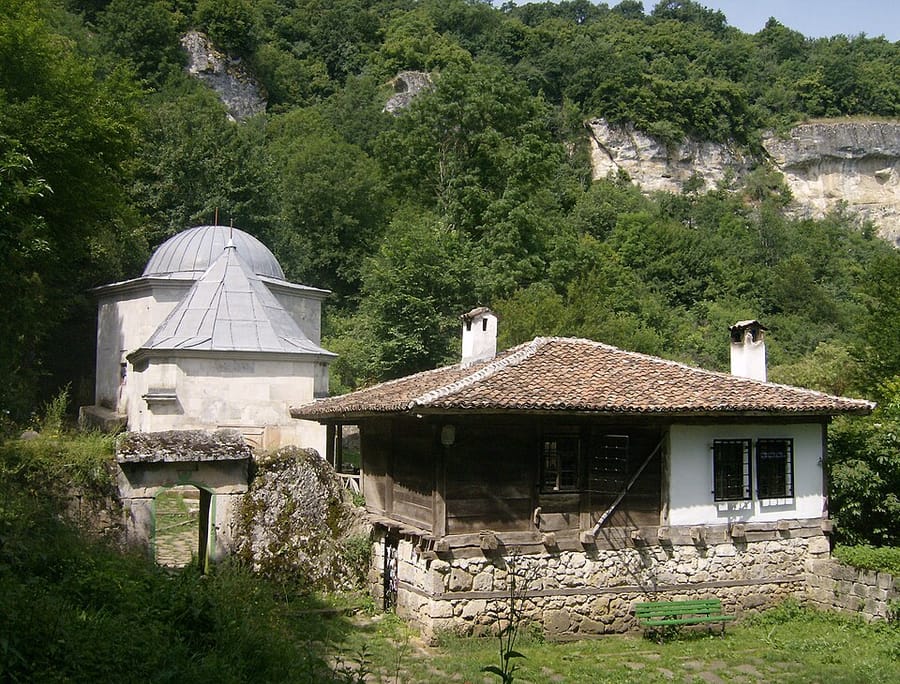
Closed like all Bektashi lodges after the abolition of the Janissaries in 1826, it revived about half a century later under Sultan Abdulaziz. An arched gateway leads into a courtyard with a graveyard on one side and two-storey buildings housing dervish cells, a kitchen and other service rooms on the other. The most interesting part is the tomb of Demir Baba, made up of a domed octagonal main chamber and an entrance section with a pyramidal roof. The cenotaph is surrounded by twelve candlesticks symbolising the Twelve Imams. The tomb resembles the one at the Akyazılı Sultan lodge.
Deliorman and Demir Baba
Deliorman, called the 'sea of trees' in old Ottoman texts, is a densely forested, secluded region; Qalandari sheikhs such as Akyazılı Sultan, Otman Baba and Kademli Baba founded their lodges here, and together with Albania it became the area of the Balkans where the Bektashi order spread most widely. According to hagiographies, Demir Baba's father was Hacı Dede, a dervish of Akyazılı Sultan, and his mother Zahide Dürdane Hatun, daughter of Turan Halife; he is also said to have taken part in the conquest of Buda and founded a lodge there. Deliorman's wrestling tradition and the stories of Demir Baba's great strength suggest he was regarded as the patron of the region's wrestlers. In the 19th century F. Kanitz claimed the lodge had been founded under Mahmud II, and K. J. Jireček confused Demir Baba with Pehlivan Ibrahim Pasha of Ruse.
The buildings of the lodge
The lodge stands in the Dimitrovo valley, also known as the Bottomless Lake, at the foot of the steep, rocky Zavet hill. The courtyard is entered through an arched gate flanked by a high wall on the left and a rock mass on the right. The ground floors of the two-storey buildings are of rubble stone with timber bonding courses and the upper floors have timber walls; their courtyard facades have a wooden-posted gallery onto which all the rooms open. A polygonal building surrounded by a porch with posts, seen in old photographs, may have been the ceremonial hall where the rituals were held.
Inside the tomb and visiting customs
In front of the tomb entrance is a tiled porch on two columns, while the dome and the conical roof are covered with lead. The door, said to be made from an ancient sarcophagus, is reported to bear the phrase 'There is no youth but Ali, no sword but Zulfiqar'. Besides the lamps around the cenotaph there are a large twelve-branched candlestick and lamps arranged on three steps known as the 'throne of Muhammad'. At the head of the cenotaph is a twelve-gored Husayni crown, at its foot a pair of metal shoes and two knives; on the walls, beside calligraphic panels, hang axes and spears, emblems of the warrior dervishes, and there is also a votive chest. Clothes left on the cenotaph for a while were put on newborn children to make them healthy, and wedding dresses laid on it were worn by brides. In the tomb at the Akyazılı Sultan lodge a heptagon was preferred to the octagon.
Source: TDV Encyclopedia of Islam (TDV İslâm Ansiklopedisi), “DEMİR BABA TEKKESİ” (M. Baha Tanman)
Related sultans
Cite as: Atlas of the Sultans, “Demir Baba Tekke · Ottoman monuments”, https://padisahlaratlasi.com/en/monuments/demir-baba-tekke/ (last updated 21 November 2026). Corrections · Image credits