TRENDEFRARAtlas of the Sultans · Ottoman monuments
Türbe of Idris Baba
Monument · Tomb, Pécs, 17th century
- Type
- Mausoleum (türbe)
- Location
- Hungary
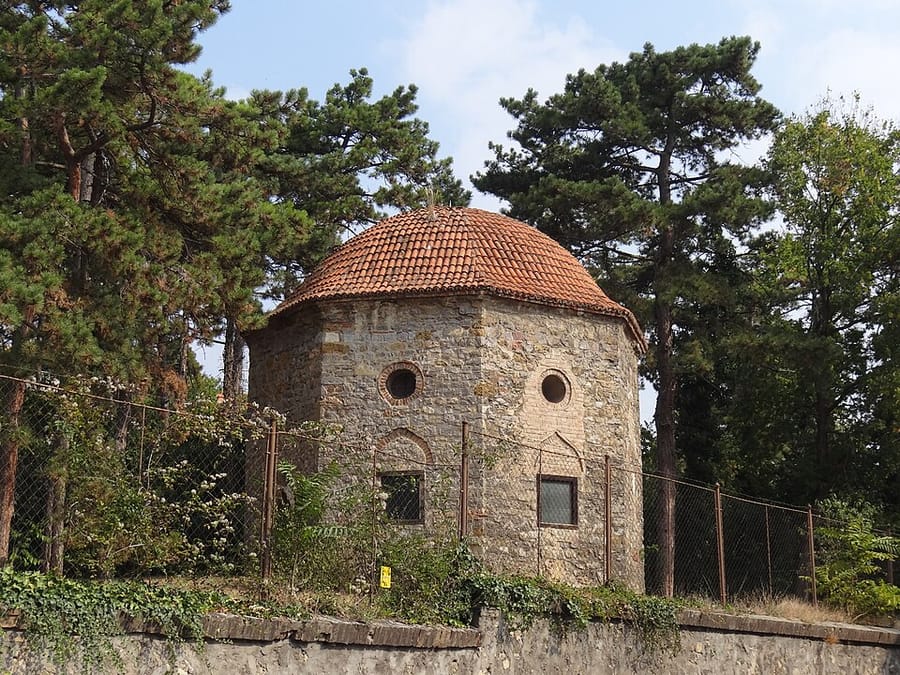

An octagonal tomb in Pécs
Standing outside the Ottoman-period walls of Pécs, this türbe (domed tomb) belongs to Idris Baba, whom the historian Ibrahim Peçevi describes as an ecstatic holy man known for his miracles. Since Peçevi writes that he met him in 1591, Idris Baba must have died at the end of the 16th or in the first years of the 17th century, after which a domed tomb was built over his grave. The octagonal building of rough rubble stone is covered by a drumless stone dome roofed with tiles.
After the Ottomans lost Hungary, the Jesuits turned the tomb into a chapel from 1693 onwards and added an apse; in the 18th and 19th centuries it served as a gunpowder store. István Möller's restoration of 1912–1913 removed the apse. During the restoration of 1961–1963, an excavation where the cenotaph had stood revealed Idris Baba's skeleton. No trace of decoration or inscription survives inside; today the grave, enclosed by a wooden railing, bears a cenotaph topped with a Qadiri dervish cap.
Idris Baba in the sources
The tomb lies in Pécs, 220 km south-west of Budapest, a good distance from the Szigetvár Gate near the Yakovalı Hasan Pasha Mosque. Peçuylu Ibrahim describes him as an ecstatic dervish among the abdals, writes that he met him on his way to the governor of Bosnia, Hasan Pasha, and notes that a high dome was later built over his grave. Evliya Çelebi, who passed through Pécs in June 1663, mentions Idris Baba only briefly, saying that he was alive in 1591 and that many miracles were told of him; he may have taken this from Peçuylu's history. The physician whom Evliya mentions outside the Szigetvár Gate, whose grave bore a marble slab inscribed in several languages, was a different person.
Alterations to the building
When the tomb was turned into a chapel, one of its windows was converted into a door with a pointed Gothic arch, the Ottoman-period door and the other windows were walled up, and one window was split and enlarged. In the last repair some of these changes were corrected and one of the damaged round windows of the upper row was restored to its original shape, while the door with Gothic jambs was left untouched. The plans and sections in the album published in 1917 by the Budapest Technical University are documents of the building's condition at that time.
Seen in the 1980s well kept in a wooded plot right next to a hospital, the tomb now stands alone; there is no trace of a dervish lodge around it, and the land was probably the Turkish cemetery of Pécs in the Ottoman period. The walls are thought to have been decorated until the end of Turkish rule. Inside, beside the cenotaph, there are also furnishings such as a candlestick and a prayer rug.
Source: TDV Encyclopedia of Islam (TDV İslâm Ansiklopedisi), “İDRİS BABA TÜRBESİ” (Semavi Eyice)
Cite as: Atlas of the Sultans, “Türbe of Idris Baba · Ottoman monuments”, https://padisahlaratlasi.com/en/monuments/turbe-of-idris-baba/ (last updated 21 November 2026). Corrections · Image credits