TRENDEFRARAtlas of the Sultans · Ottoman monuments
Hamza Bey Mosque (Bitola)
Monument · Mosque, Bitola, 15th–16th century
- Type
- Mosque
- Location
- Bitola, North Macedonia
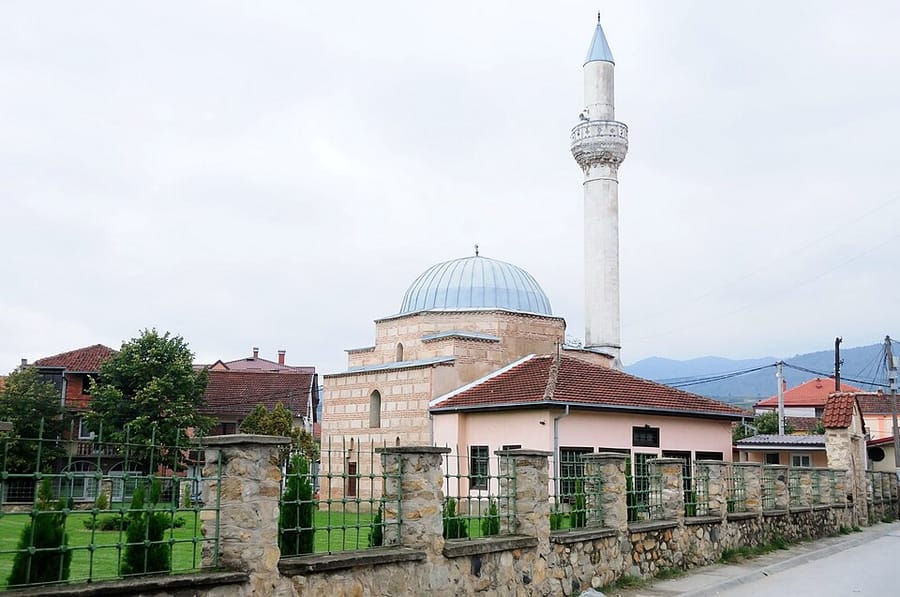

A classical-period mosque of unknown date
Neither the construction date of this mosque in Bitola (Manastır) nor the identity of its founder, Hamza Bey, has been established. Kroum Tomovski dated the building to the 18th century, but Ekrem Hakkı Ayverdi disagreed. Since its masonry technique, in which each stone is framed on all four sides by bricks, is common in Anatolia and the Balkans especially in 15th-century buildings, the mosque cannot be dated as late as the 18th century; its architecture points to the classical Ottoman age. According to its inscription, the courtyard wall and gate took their present form in 1856–57.
The rectangular mosque has a lead-covered dome resting on an octagonal drum, and its mihrab is set in a projecting bay. Above the windows, instead of the usual pointed relieving arches, there are shallow niches narrowing upwards in three steps, a detail foreign to mosque architecture. The twelve-sided minaret of dressed stone has kept its original appearance. The original portico collapsed at an unknown date. A restoration begun in 1995 stopped after two years, and the mosque is not open for worship.
The question of identity and building details
When Ekrem Hakkı Ayverdi studied it, the mosque was badly dilapidated, closed, and its windows walled up with stones. The Hamza Bey Mosque is not named among the mosques listed in the History of the Province of Monastir published by Mehmed Tevfik Bey while the city was still under Ottoman rule; the building is therefore thought to have been known by another name. The courtyard wall is of rubble stone and has a gate with a semicircular arch.
In the walls of the main building, single courses of neatly dressed stones lie between bands of four brick courses; two bricks set vertically between the stones frame each stone on all four sides. The octagonal drum carrying the dome is blind. The mihrab projection has a pair of windows above, while the side facades have one window low in the projection and two in the prayer hall. The stepped niches above the windows resemble a mihrab; in Turkish art this form is occasionally seen in the passages of baths. The balcony of the minaret is carried on muqarnas. The restoration of 1995 began on the initiative of the Islamic Community of the Republic of Macedonia.
Source: TDV Encyclopedia of Islam (TDV İslâm Ansiklopedisi), “HAMZA BEY CAMİİ” (Semavi Eyice)
Cite as: Atlas of the Sultans, “Hamza Bey Mosque (Bitola) · Ottoman monuments”, https://padisahlaratlasi.com/en/monuments/hamza-bey-mosque-bitola/ (last updated 21 November 2026). Corrections · Image credits