TRENDEFRARAtlas of the Sultans · Ottoman monuments
Arabati Baba Tekke
Monument · Sufi lodge (tekke), Tetovo, 16th century
- Type
- Dervish lodge
- Location
- North Macedonia
- Built
- 1551
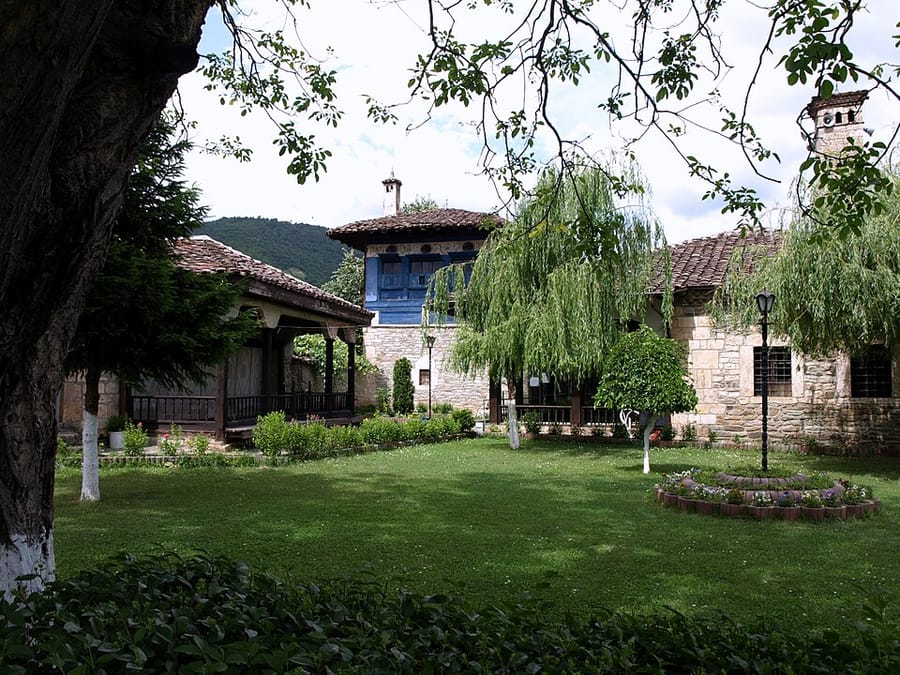

The Bektashi centre of Rumelia
Located in the Tekke quarter south-west of Kalkandelen (Tetovo), the lodge is one of the most important Bektashi centres in Rumelia. It was probably founded by Sersem Ali Baba, who was trained at the Bektashi lodge (asitane) of Dimetoka and came to Kalkandelen in 1551. According to tradition, Harabati Baba (d. 1780), regarded as its second founder, built a tomb here for Sersem Ali Baba. The founding date is uncertain: some researchers propose 1799 or 1832, while Ekrem Hakkı Ayverdi holds that the lodge, built towards the end of the 16th century, was enlarged by Receb Pasha in Harabati Baba's time.
Laid out over an area of 26,700 m², the complex stands in a courtyard enclosed by crenellated walls and comprises a masjid, a hall for the sema ceremony (semahane), two tombs, a guesthouse, a fountain pavilion, dervish quarters, a kitchen and a harem wing; the two fountains in the courtyard date from 1791 and 1844. The walls of the masjid and the harem wing are painted with landscapes and plant motifs, and the ceilings are decorated with wood carving. Active until the Balkan War of 1912, the lodge then fell into ruin; in 1967 it was restored by a textile factory in Kalkandelen and opened to tourism.
Founders and legends
According to legend, Sersem Ali Baba was a vizier of Suleiman the Magnificent or the brother of Mahıdevran Sultan; he left office despite the sultan's insistence, wandered through various tekkes and finally went from Tetovo to Najaf, where he died. He must be the Sersem Ali Baba whom Sadettin Nüzhet Ergun describes as head of the Hacı Bektaş tekke in 1551, who probably died in Tetovo in 1569. The second founder, Harabati Baba, is said to have come to Rumelia with four companions; in Tetovo he saw a burning lamp, declared it to be the soul of Sersem Ali Baba and had a tomb built for him.
According to Hasluck, Sersem Ali Baba's grave was discovered by Muharrem Baba and the tomb was built in 1832 by Rıza Pasha. Lines by the Bektashi poet Turabi show that Receb Pasha visited the tekke and gave assistance. Eleven sheikhs served at the tekke after Harabati Baba; its endowment deed of 1815 is in the Tetovo City Archive.
The tombs and other buildings
The courtyard, enclosed by rubble-stone walls, has a gate on each of its four sides. The tomb of Sersem Ali Baba is covered by a twelve-segment dome on a twelve-sided body; if Sersem Ali Baba really died in Najaf, the building must be a commemorative tomb. The graveyard in front holds eleven graves belonging to Receb Pasha and the sheikhs and dervishes of the tekke; Harabati Baba's open tomb stands within a hall on wooden posts. The hip-roofed masjid receives light through seven windows; only the east wall of the semahane, the hall for the sema ceremony, still stands.
West of the şadırvan, arranged as an open hall on wooden posts, is an octagonal pool with a fountain; above the carved cedar door leading to the arbour is a Qur'anic verse (al-Hijr 15:46) in gilded wood carving. The kitchen is the only building of the complex still serving its original function.
Decoration, library and endowments
The tekke's painted decoration resembles the wall paintings of the Alaca (Pasha) Mosque in Tetovo; craftsmen of Torbeş origin from the village of Mala Reka are known to have worked in both complexes. A lion figure, a Bektashi symbol, can be seen on the outer wall of the harem quarters. In 1912 the tekke's library held 216 manuscripts; today they are probably in the Oriental manuscripts department of the Kliment Ohridski library in Skopje and in the Isa Bey Library in Skopje. Non-Muslim Macedonians are known to have celebrated their religious and national holidays in the tekke complex; besides Tetovo, the tekke had rich endowments in Istanbul, Tirana, Elbasan and Thessaloniki.
Source: TDV Encyclopedia of Islam (TDV İslâm Ansiklopedisi), “HARÂBÂTÎ BABA TEKKESİ” (Muhammed Aruçi)
Related sultans
Cite as: Atlas of the Sultans, “Arabati Baba Tekke · Ottoman monuments”, https://padisahlaratlasi.com/en/monuments/arabati-baba-tekke/ (last updated 21 November 2026). Corrections · Image credits