TRENDEFRARAtlas of the Sultans · Grand viziers
Baltacı Mehmed Pasha
Grand vizier, 1704–1706 and 1710–1711
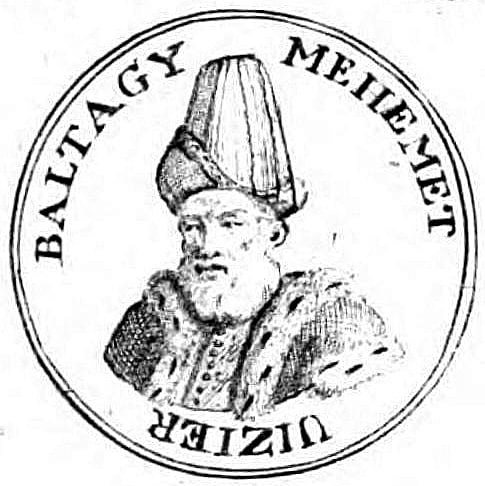 AI

From Osmancık to the palace
He was born in Osmancık, today part of the province of Çorum. In his youth his thirst for learning took him as far as Tripoli, Tunis and Algiers. On his return to Istanbul he entered the palace through his relative Hacı Sefer Ağa; there he served in turn as a halberdier (baltacı), a scribe and a muezzin. During this time he formed a close relationship with Prince Ahmed.
During the Edirne Incident of 1703 he was in close contact with the rebels and worked hard for the accession of Ahmed III. He hoped to rise rapidly thanks to his closeness to the new sultan; but Grand Vizier Moralı Damad Hasan Pasha, who saw him as a rival, did not promote him for a long time. Although he was appointed master of the horse (mirahur) on 28 November 1703, he was soon removed from the palace by being sent as a tax collector to the regions of Tripoli and Aleppo.
His first grand vizierate
He was able to return to Istanbul during the grand vizierate of Kalaylıkoz Ahmed Pasha, and on 6 November 1704 he became grand admiral (kaptan-ı derya) with the rank of vizier. The article states that he engaged in certain schemes that led to the dismissal of Kalaylıkoz Ahmed Pasha, and in this way moved into the grand vizierate on 25 December 1704. In this first grand vizierate he was dismissed on 3 May 1706 without having done anything of importance beyond putting his own partisans into office.
He was then sent to the governorship of Erzurum and, in 1707, to the guardianship of Chios. On 21 January 1709 he became governor of Aleppo.
The Pruth campaign
On 18 August 1710 he became grand vizier for the second time in place of Köprülüzade Numan Pasha. His first task was to deal with Ottoman-Russian relations, which had become tense since King Charles XII of Sweden (“Demirbaş Şarl”) had taken refuge in Ottoman territory. On 19 February 1711 he was appointed commander-in-chief of the Pruth campaign, opened against the Russians who were attacking the northern borders, and he left Istanbul on 9 April 1711.
The army, which set out after the preparations were completed, met the Russian forces on 18 July 1711 near the marshes of the river Pruth. In this battle, known in history as the Battle of the Pruth and lasting about four days, the Russian Tsar Peter I, surrounded and helpless, proposed a peace that would meet the Ottomans' demands. With Baltacı Mehmed Pasha's approval, the treaty was concluded on 22 July 1711; Ahmed III, pleased with it at first, summoned him to Istanbul.
Dismissal, exile and assessment
Tsar Peter's failure to fulfil his promises after the grand vizier had freed his army from encirclement led to the formation of an opposition against the grand vizier in Istanbul; his slowness in obtaining the results of the treaty was also misinterpreted. Baltacı Mehmed Pasha, who had come to Edirne on Ahmed III's orders, was relieved of the seal on 20 November 1711 and in December 1711 exiled to Lesbos (Midilli), confined to a fortress (kalebent). In July 1712 he was sent to the island of Lemnos (Limni), and he died there in September of the same year; his grave is in the burial ground where Niyazi-i Mısri is buried. When he died he was over fifty; he had a son and a daughter named Fatma. The author of the article assesses him as ambitious, inclined to intrigue and not very capable in the administration of the state.
Source: TDV Encyclopedia of Islam, “BALTACI MEHMED PAŞA” (M. Münir Aktepe)
Related sultans
City: Çorum
Cite as: Atlas of the Sultans, “Baltacı Mehmed Pasha · Grand viziers”, https://padisahlaratlasi.com/en/grand-viziers/baltaci-mehmed-pasha/ (last updated 21 November 2026). Corrections · Image credits