TRENDEFRARAtlas of the Sultans · Ottoman monuments
Husameddin Pasha Mosque
Monument · Mosque, Štip, 15th–16th century
- Type
- Mosque
- Location
- North Macedonia
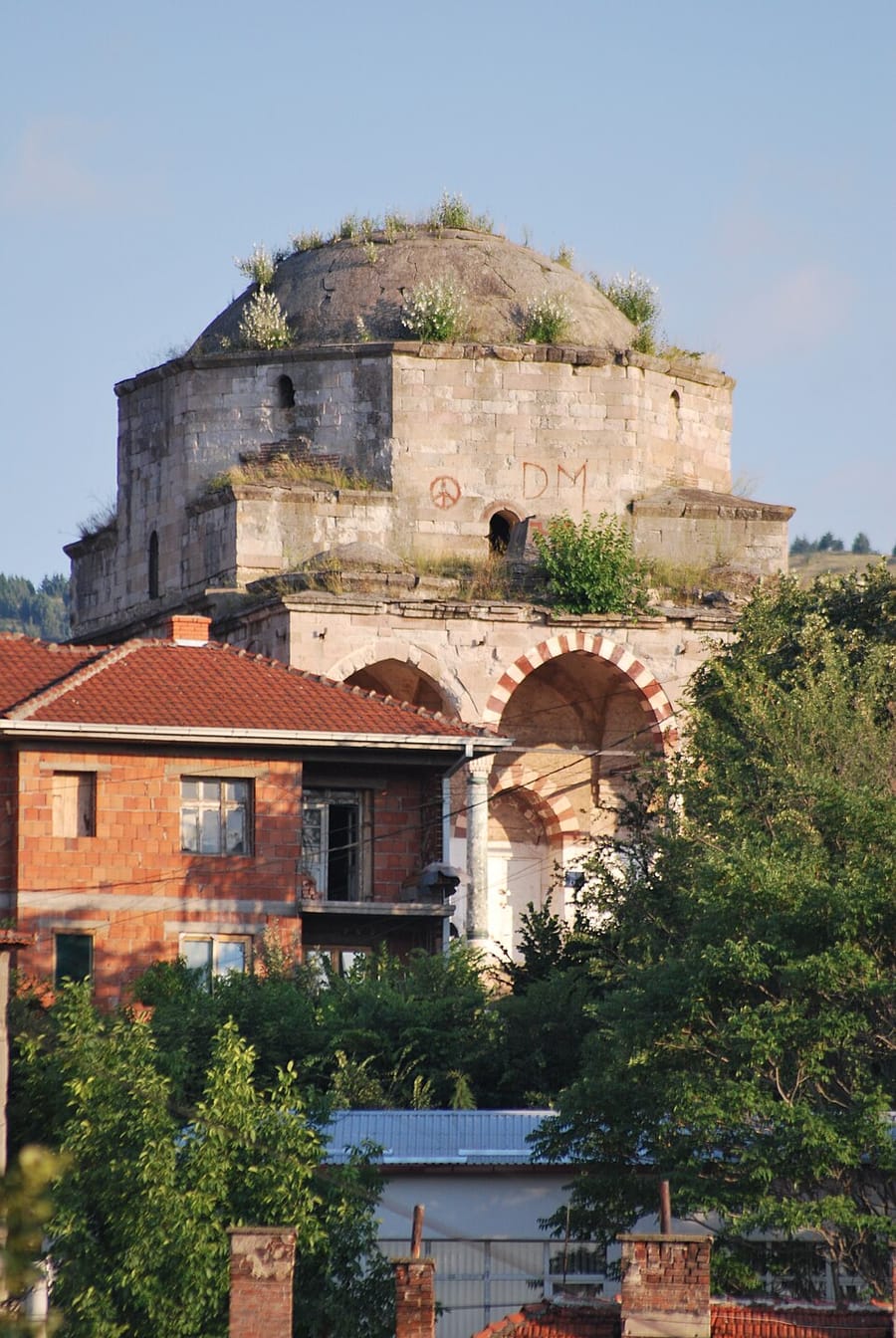

An early mosque in Štip
Also known as the Hüsam Pasha Mosque, the building cannot be dated precisely. A foundation register places it in the Tekye-i Bala quarter, and Evliya Çelebi lists it among the mosques of Štip he saw in 1661–62. The resemblance of its five-sided mihrab projection to buildings of the reign of Mehmed the Conqueror in Istanbul, together with the stonework of its walls, supports a date in the 15th–16th centuries.
The square mosque, about 12 × 12 metres outside, is built of carefully dressed stone. In front is a three-bay portico on four columns; its central arch, in stones of two colours, is more ornate than the others. The prayer hall is covered by a dome on a tall octagonal drum pierced with windows. Only the base and transition zone of the minaret still stand. Found ruined and closed by Ekrem Hakkı Ayverdi, the building was in use as an Orthodox church in 1998.
The portico
Because of the difference in level towards the qibla side, the portico stands high and is reached in the centre by a double staircase of seven steps on each side. Of its four columns, the two in the middle are of coloured porphyry with muqarnas capitals, while those at the corners are of white marble with simpler lozenge capitals. The mosque's entrance door also opens within a pointed arch of two-coloured stone.
The five-sided mihrab projection
On the qibla side a five-sided, apse-like mihrab projection juts out from the square body. Parallels are found in Istanbul buildings of Mehmed the Conqueror's time: the rear façade of the Çinili Köşk, the Davud Pasha Mosque and the hospital of the Fatih Complex, destroyed in the fire of 1918. The mihrab of the 15th-century Beylerbeyi Mosque in Edirne also sits in a five-sided projection. The projection has rectangular windows under pointed relieving arches below and smaller pointed-arched windows above; its semi-dome rests on a five-sided drum with windows.
As often in Ottoman buildings in Rumelia, the drum of the dome is very high; broad mouldings strongly mark the division between wall, drum and dome. On his visit Ayverdi found most of the windows filled in with rubble. The mouldings on the many-sided base of the minaret recall the minaret of the Koca Mustafa Pasha Mosque in Istanbul.
The nearby tomb
A short distance beyond the minaret stands an octagonal tomb with a tiled roof containing a single sarcophagus. It is said to belong to a saint called Meydin Baba; since Evliya Çelebi reports that Sheikh Muhyiddin Rumi was buried here, the name Meydin may derive from Muhyiddin.
Source: TDV Encyclopedia of Islam (TDV İslâm Ansiklopedisi), “HÜSÂMEDDİN PAŞA CAMİİ” (Semavi Eyice)
Cite as: Atlas of the Sultans, “Husameddin Pasha Mosque · Ottoman monuments”, https://padisahlaratlasi.com/en/monuments/husameddin-pasha-mosque/ (last updated 21 November 2026). Corrections · Image credits