All toursTRENDEFRAR
Ottoman lands

Map tour · 1630–1683 · 9 stops · 8 min read

The Travels of Evliya Çelebi

From Istanbul to Cairo: the forty-year journeys of the Seyahatname

Scroll to continue ↓

19 August 1630

A dream and Istanbul
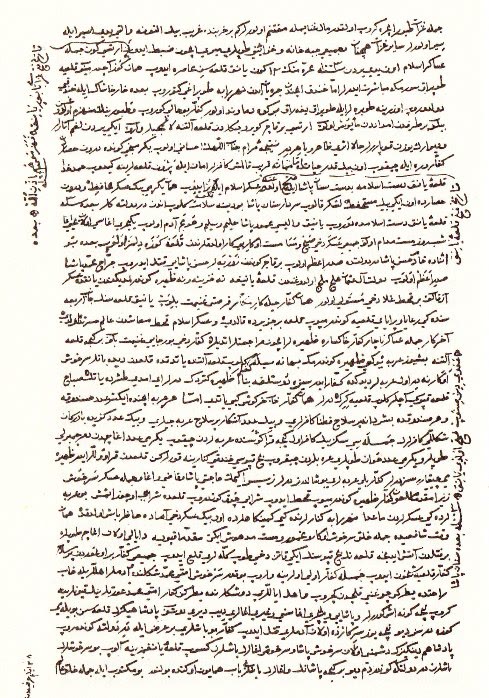
A text page from Volume VII of the Seyahatname manuscript.
A text page from Volume VII of the Seyahatname manuscript. · Image: Wikimedia Commons (public domain)

According to his own work, Evliya Çelebi was born on 25 March 1611 at Unkapanı in Istanbul; his father, Derviş Mehmed Zılli Efendi, was chief goldsmith of the palace. He studied at a madrasa and in the palace school (Enderun), received musical training thanks to his fine voice, and by his own account often appeared before Murad IV. He traces his travels to a dream on the night of Ashura in 1630: kissing the Prophet's hand in the Ahi Çelebi Mosque, instead of asking for “intercession” (şefaat) he said “travel (seyahat), O Messenger of God”. Advised by Abdullah Dede, sheikh of the Kasımpaşa Mevlevi lodge, to describe Istanbul first, he toured his native city district by district, gathering information in gatherings and coffeehouses. The first volume of the Seyahatname is devoted entirely to Istanbul.
1640

The first journey: Bursa

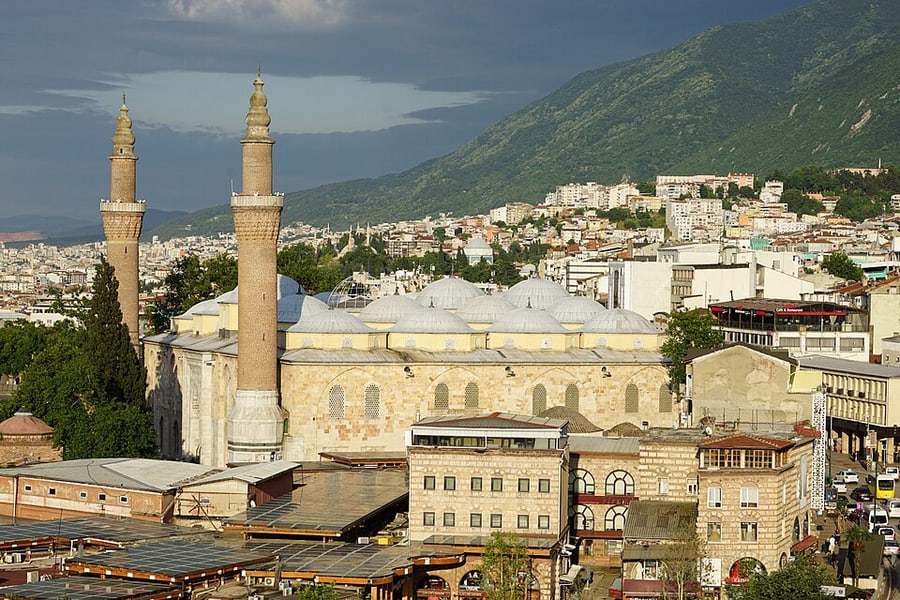
Bursa's Grand Mosque (Ulu Cami) seen from the citadel, with Mount Uludağ behind.
Bursa's Grand Mosque (Ulu Cami) seen from the citadel, with Mount Uludağ behind. · Image: Wikimedia Commons (CC BY-SA 4.0, Canercangul)

He made his first journey outside Istanbul in 1640, to Bursa, without his father's permission. On his return his father gave him leave to travel and advised him to write down what he saw as a travel book. Probably in these years he also made short trips to Kütahya, Manisa and Izmit because of his family's connections; it appears that his ancestors had lived in Kütahya and settled in Istanbul after the conquest. In the Seyahatname each city is described in a set order, from its fortress to its tombs. According to the TDV, Evliya's figures are sometimes exaggerated but often match the real numbers; yet besides exaggeration the work frequently contains misreported facts and contradictions. To catch the reader's interest Evliya includes incredible, strange events, and sometimes tells a story he had heard as if he had lived it himself.

1641 – 1645

Trabzon, Azov and the Crimea

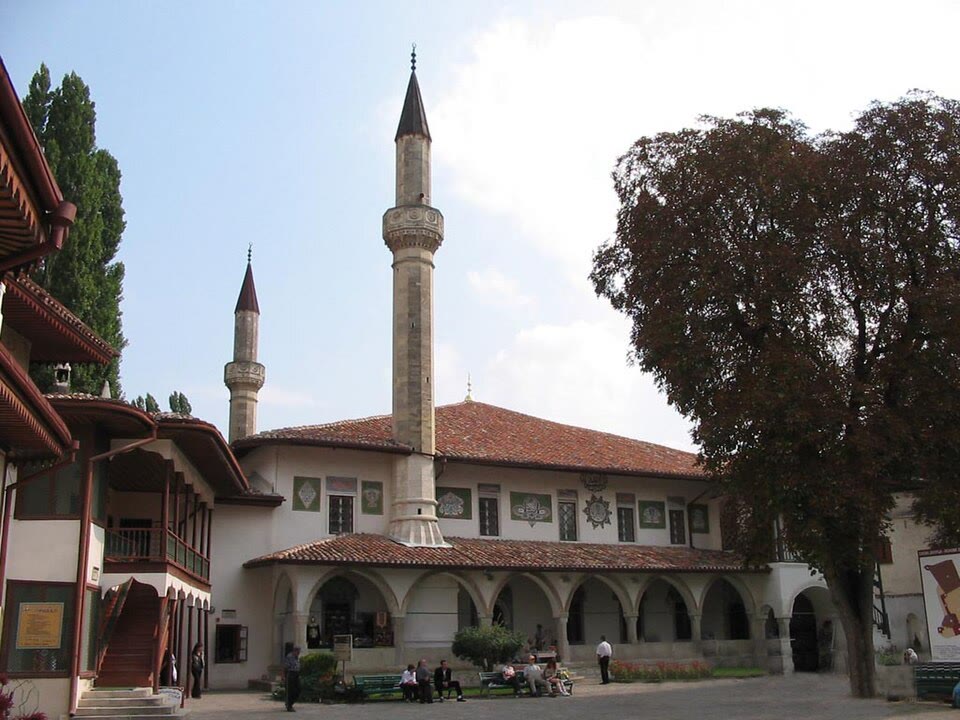
The Great Khan's Mosque in the palace of the Crimean khans at Bakhchysarai.
The Great Khan's Mosque in the palace of the Crimean khans at Bakhchysarai. · Image: Wikimedia Commons (CC BY-SA 3.0, Sergiy Klymenko)

His first journey to distant lands began when Ketenci Ömer Pasha was appointed governor of Trabzon: with the pasha he went by sea to Trabzon and from there to Anapa. In 1641 he joined the campaign under Hüseyin Pasha to retake the fortress of Azov, which the Cossacks had seized in 1637. When the siege of some three months failed, he crossed to the Crimea, was the guest of Bahadır Khan, spent the winter in Bakhchysarai and in spring was present at the conquest of Azov; according to the TDV article on Azov, in 1642 the Cossacks set the fortress on fire and fled when the Ottoman army and the Crimean khan arrived. Sailing back to Istanbul, his ship almost sank in a violent storm; probably out of this fear he did not travel for about four years. In 1645 he joined the Cretan campaign with Yusuf Pasha's army and witnessed the conquest of Chania (Hanya).

1646 – 1650 and the 1650s

Eastern frontier: Erzurum, Tabriz, Van

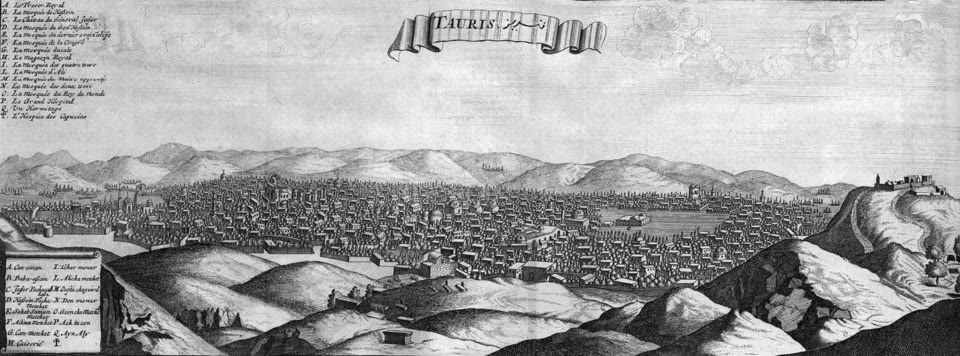
View of Tabriz in 1673 from Jean Chardin's travel account.
View of Tabriz in 1673 from Jean Chardin's travel account. · Image: Wikimedia Commons (public domain)

When Defterdarzade Mehmed Pasha became governor-general of Erzurum in 1646, Evliya joined his retinue as muezzin and companion. He took part in the governor's Şuşik campaign and escorted a Safavid envoy returning to Tabriz; he toured Azerbaijan and Georgia, saw the regions of Baku, Tbilisi, Yerevan, Gümüşhane and Tortum, and was present at the Georgian campaigns with the conquest of Gönye. He also witnessed the revolt of Varvar Ali Pasha. In August 1648 he went to Damascus with Murtaza Pasha and visited many towns of Syria and Palestine, returning to Istanbul via Sivas in 1650. In the 1650s, when his kinsman Melek Ahmed Pasha became governor-general of Van, he went east again, travelled through eastern Anatolia and on various missions crossed into Iran and towards Baghdad. Volume IV of the Seyahatname describes Diyarbekir, Bitlis, Van and, in Iran, places such as Tabriz and Hamadan.

1651 – 1662

With Melek Ahmed Pasha in Rumelia

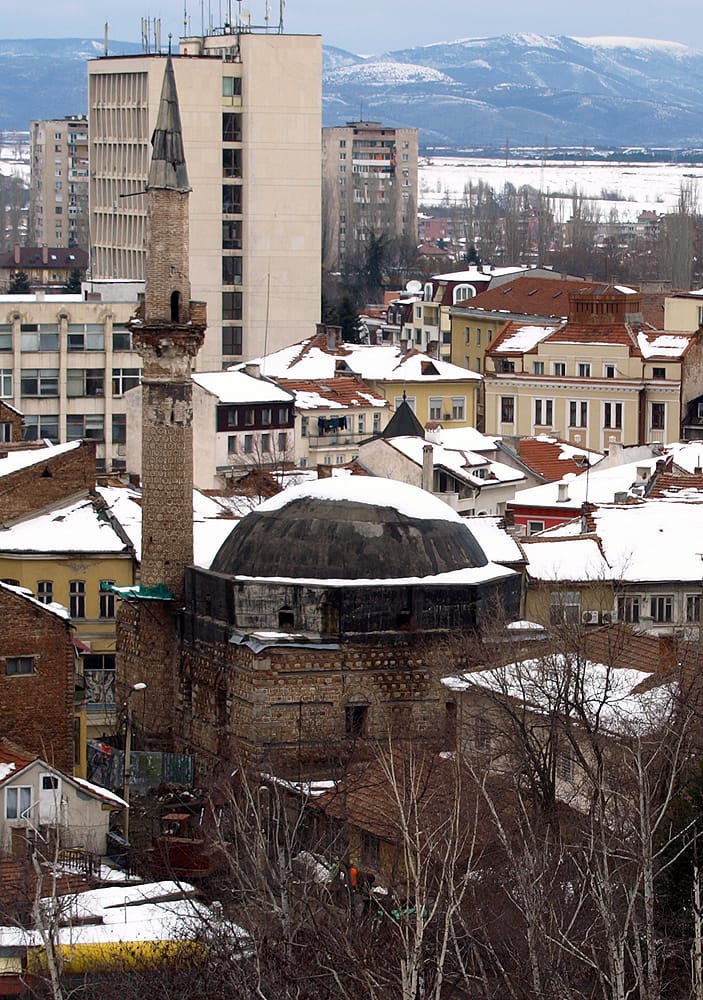
The Fatih Sultan Mehmed Mosque in Kyustendil (Köstendil).
The Fatih Sultan Mehmed Mosque in Kyustendil (Köstendil). · Image: Wikimedia Commons (CC BY-SA 3.0, Edal Anton Lefterov)

When Melek Ahmed Pasha became grand vizier in 1650, Evliya became one of his closest men; because he never left the pasha's side he was called “Melek Ahmed Pashalı”. When the pasha was dismissed after a guild uprising caused by his forced issue of debased coinage and made governor-general of Özi (Ochakiv), Evliya went with him, saw Ruse, Silistra and Babadag and took part in surveying villages and towns. In May 1657 he joined the campaign against Rákóczi, then campaigns against the Russians and Cossacks alongside the Crimean Khan Mehmed Giray IV. In 1659 he set out with the convoy taking the voivode of Moldavia to his country, was on the Várad campaign, toured Bosnia with its governor-general Melek Ahmed Pasha and in 1661 joined Köse Ali Pasha's Transylvanian campaign. A wall inscription of 1661 in the mosque of Kyustendil is also his trace. After wintering in Belgrade he was sent to Albania to collect revenues.

1663 – 1665

Uyvar campaign and the Vienna embassy

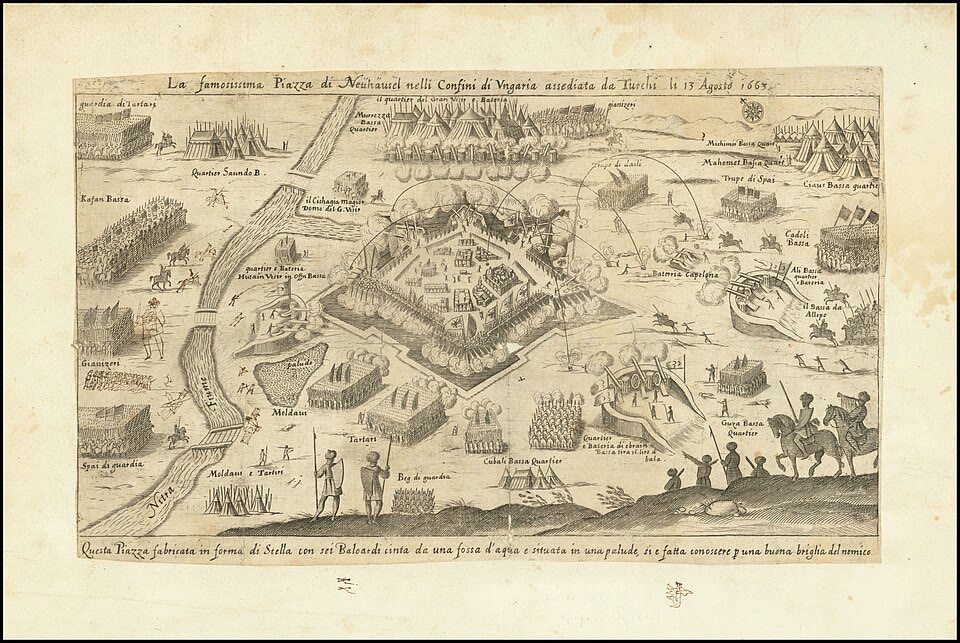
A contemporary Italian engraving of the 1663 siege of Uyvar (Neuhäusel).
A contemporary Italian engraving of the 1663 siege of Uyvar (Neuhäusel). · Image: Wikimedia Commons (public domain)

In 1663 he joined Köprülüzade Fazıl Ahmed Pasha's Austrian campaign and was present at all its stages; according to the TDV article on Uyvar, the fortress surrendered after a siege lasting from 17 August to 26 September 1663. After taking part in operations on the Venetian border in Herzegovina, he returned to Hungary, witnessed the battle on the Raab and described it at length. After the Treaty of Vasvár of 9 August 1664 he went to Vienna in the retinue of the envoy Kara Mehmed Pasha; a document in the Austrian archives shows that in 1665 he was in this embassy as its muezzin. He writes that he met Emperor Leopold I and Montecuccoli and, with a permit, travelled through Germany, Sweden, Denmark, Holland and France. According to the TDV, this Western European journey, told briefly with a few clichés, is a fictional one that he planned but never made.

After 1665 – December 1670

From the Crimea to Candia

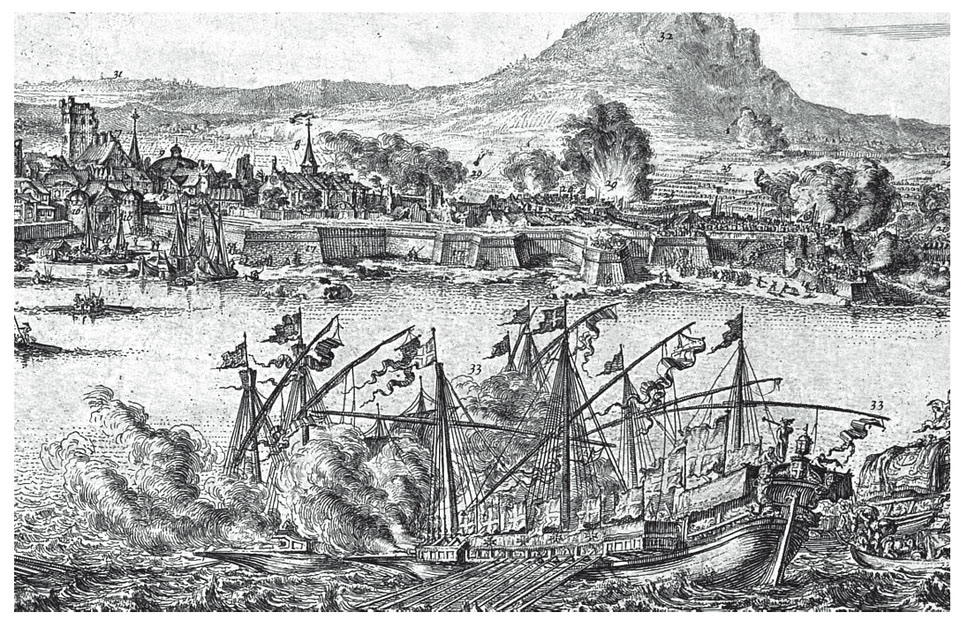
Candia besieged by the Ottoman army, in an engraving by Antoine de Fer dated 1669.
Candia besieged by the Ottoman army, in an engraving by Antoine de Fer dated 1669. · Image: Wikimedia Commons (public domain)

Some time after Vienna, by his own account, he crossed by way of the Crimea into the Caucasus and reached the Volga, then, after touring these lands, returned to the fortress of Azov with an embassy convoy. Going from Caffa to Bakhchysarai, he took part in some campaigns of the Crimean khan Adil Giray and returned to Istanbul in May 1668. Volume VII of the Seyahatname also describes the languages, customs and traditions of the Crimea, Daghestan and the peoples of the Caucasus. In December of the same year he toured Rumelian cities such as Edirne, Komotini and Thessaloniki and sailed from Nauplion to Crete. He witnessed various phases of the siege of Candia and included the Candia victory proclamation in his work; the city surrendered by agreement on 6 September 1669. He then took part in suppressing the Maniot rebels in the Morea, toured Albania and returned to Istanbul in December 1670.

From May 1671

On the pilgrimage road

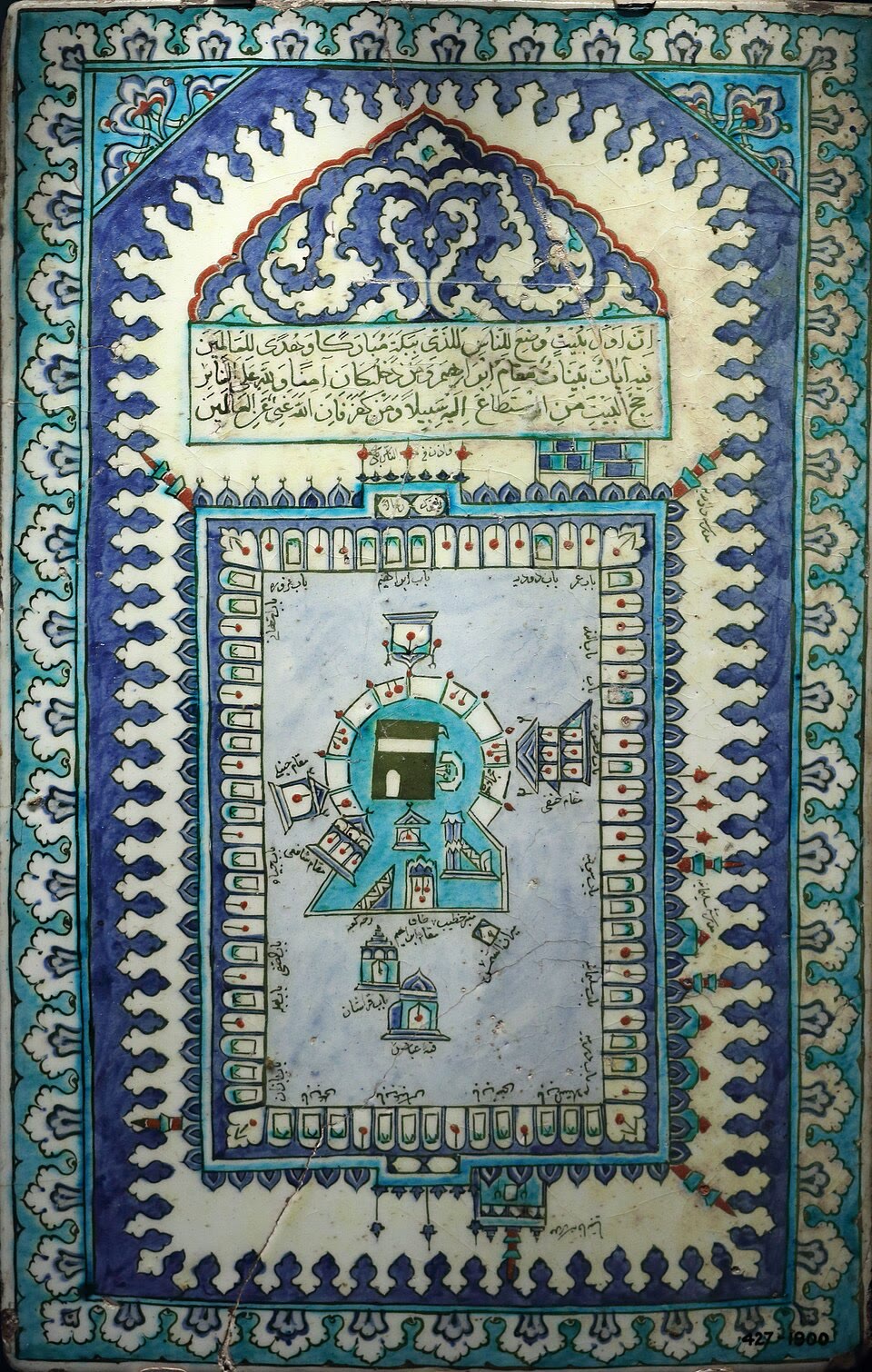
An Iznik tile depicting the Great Mosque and the Kaaba at Mecca (Victoria and Albert Museum).
An Iznik tile depicting the Great Mosque and the Kaaba at Mecca (Victoria and Albert Museum). · Image: Wikimedia Commons (public domain)

After visiting the tomb of Eyüp Sultan on the Night of Power, he saw his father and his teacher in a dream advising him to make the pilgrimage. In May 1671 Evliya left Istanbul with his friend Saili Çelebi, three companions and eight slaves; for the first time he set out on a long journey with his own small group rather than with a convoy. From Bursa, Kütahya and Afyon he went down to Izmir, crossed to the islands of Chios and Samos, toured Aydın, the coast of Menteşe, Kos and Rhodes, using the Rhodes land registry when describing the islands. He then visited the towns of southern Anatolia he had not seen before; a wall inscription of 1671 by him has been found in Adana. Via Maraş, Ayıntab and Kilis he passed into Syria and set out from Damascus for the pilgrimage with a caravan that included the governor-general Hüseyin Pasha. He recorded the pilgrimage route in detail in Volume IX.

After the pilgrimage – 1682 or 1684 (?)

Last years in Egypt

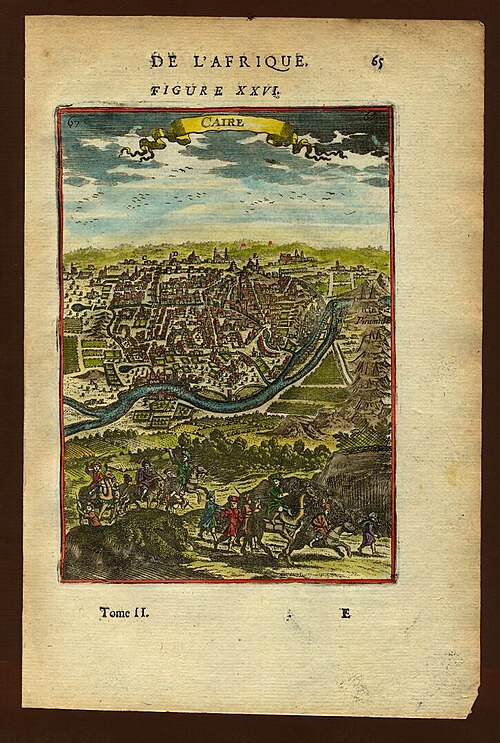
View of Cairo from Alain Manesson Mallet's Description de l'Univers (first edition 1683).
View of Cairo from Alain Manesson Mallet's Description de l'Univers (first edition 1683). · Image: Wikimedia Commons (public domain)

After performing the pilgrimage he went to Egypt, and from there travelled through the whole region and the provinces of Sudan and Abyssinia. A Greek travel pass issued to him at St Catherine's Monastery on Mount Sinai is one of the two documents outside his own work that attest to his existence. He stayed in Egypt for more than ten years and wrote his work there; since Volume X, devoted entirely to Egypt, breaks off abruptly and incomplete, it is assumed that he died before finishing it. The place and date of his death are uncertain: M. Cavid Baysun first suggested around 1682, then stated that he lived to see the second siege of Vienna and was still alive in 1684; it is also claimed that he returned to Istanbul and was buried in the family cemetery. In 1742 the manuscripts of the Seyahatname were sent from Egypt to Istanbul, to Hacı Beşir Agha.

End of the tour

The texts are based on the TDV Encyclopedia of Islam articles below. Borders are drawn from the atlas's regional data and are approximate; see the Method page.

Sources

More tours