TRENDEFRARAtlas of the Sultans · Ottoman monuments
Daut Pasha Hammam
Monument · Hammam, Skopje, 15th century
- Type
- Bathhouse (hammam)
- Location
- Skopje, North Macedonia
- Built
- 1484
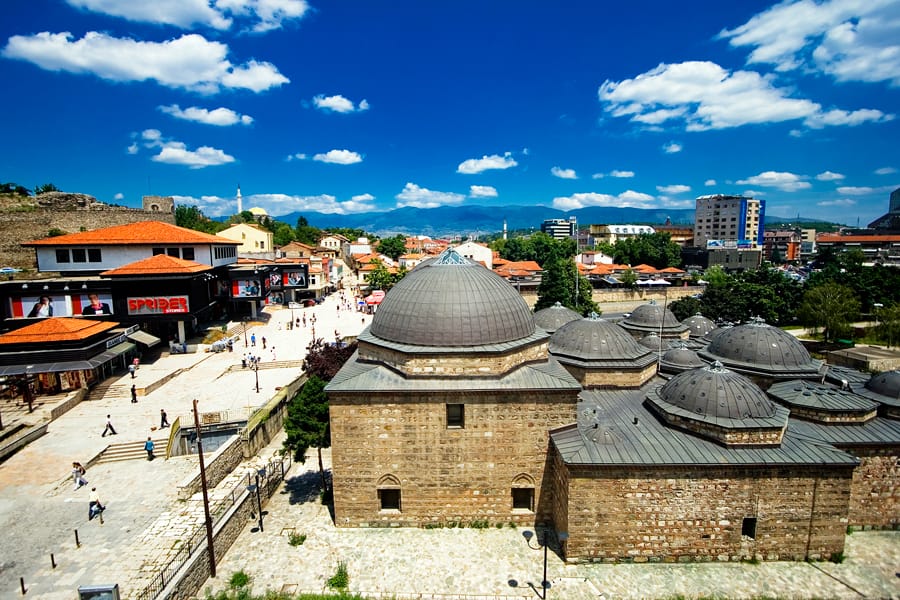

A double bath by the Vardar
The bath was built in the centre of Skopje (Üsküp), at the head of the Vardar Bridge, by Koca Davud Pasha (d. 1498), who served for many years as grand vizier under Sultan Bayezid II, to provide income for his pious foundations. No inscription or record gives its date of construction: Ekrem Hakkı Ayverdi lists it among the works of the reign of Mehmed the Conqueror, while Aydın Yüksel cites the date 1484 given by another researcher and assigns it to the reign of Bayezid II. It is one of the most imposing Ottoman buildings in Rumelia.
Its facades of alternating stone and brick courses and its twin changing-hall domes, about 11.60 m in diameter, give the building a monumental appearance. The hot room of the men's section has four iwans and three private cubicles (halvet), while the women's section has a plan rarely found in Turkish baths, with a domed centre and a pair of cubicles. Domed side rooms entered from the warm room, whose purpose is unknown, have no parallel in known Ottoman baths. Its varied muqarnas and star-shaped skylights are notable. Repaired after 1948, the bath was converted into a museum of inscriptions and an art gallery.
Revenue and plan features
According to the Istanbul Endowments Survey Register of 1546, the bath yielded an income of 5,838 akçe, a small sum for a building of this size. The entrance to the men's section is on the front façade, flanked by windows with pointed relieving arches. The women's section, entered from a side street, has no windows; it receives light only from the lantern at the centre of its dome.
The warm room, usually rectangular and tripartite in Ottoman baths, is here a square domed space in both wings. Between the warm room and the side spaces there are double latrines in the men's section and a single one in the women's section. In the men's hot room the place of the fourth private cubicle is taken by the adjoining domed space; the three-iwan main space of the women's hot room is formed with the help of two columns.
Domes and place in the city
The domes of the changing halls rest on blind octagonal drums; throughout the spaces the transition to domes and vaults is made with muqarnas, each of a different pattern, and Turkish triangles. The Survey Register also reveals that there was a Small Davud Pasha Bath near the Vardar; that building was demolished and has disappeared. The TDV article on Skopje lists the Davud Pasha Bath, together with the Isa Bey Double Bath and the Şengül Bath, among the city's important architectural works. Semavi Eyice describes the bath as one of the finest and most valuable Turkish monuments left abroad and considers it gratifying that it is preserved in good condition, even if not in its original function.
Source: TDV Encyclopedia of Islam (TDV İslâm Ansiklopedisi), “DÂVUD PAŞA HAMAMI” (Semavi Eyice)
Related sultans
Cite as: Atlas of the Sultans, “Daut Pasha Hammam · Ottoman monuments”, https://padisahlaratlasi.com/en/monuments/daut-pasha-hammam/ (last updated 21 November 2026). Corrections · Image credits