TRENDEFRARAtlas of the Sultans · Grand viziers
Nevşehirli Damad Ibrahim Pasha
Grand vizier, 1718–1730
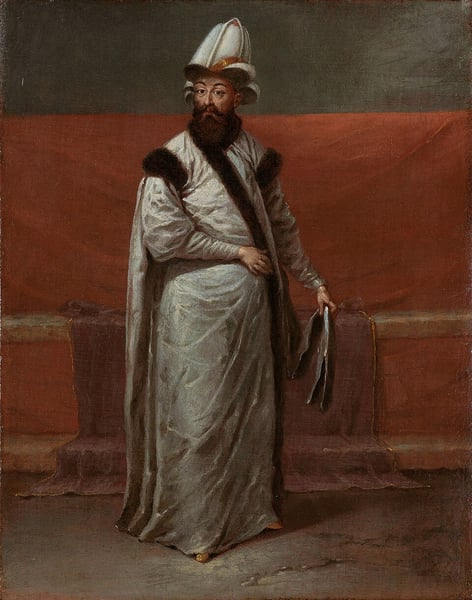 AI

From Muşkara to the palace
He was born, probably in 1662, in Nevşehir, formerly called Muşkara. His father was Sipahi Ali Ağa, known as the voivode of Izdin, and his mother Fatma Hanım. In 1689 he came to Istanbul to see his relatives and find work; through a relative he entered first the Confectioners' (Helvacılar) and then the Halberdiers' (Baltacılar) corps of the palace, and rose to be secretary of endowments of the Old Palace. When he was summoned to the Edirne Palace as assistant secretary to the ağa of the Abode of Felicity (Darüssaade ağası, the chief black eunuch), he came to know Prince Ahmed well and became his trusted man. After the Edirne Incident of 1703 he remained secretary of the Abode of Felicity for six years; he turned down the offers of a vizierate that came to him many times.
Through the efforts of those who were jealous of his closeness to the sultan he was removed from the palace in 1709, his property was confiscated and he was exiled to Edirne. Later, as mevkufatçı (an official of the finance department), he took part in Şehid Ali Pasha's Morea campaign of 1715. On the Petrovaradin campaign, when the grand vizier fell in battle, he saved the army from disintegrating with the measures he took, and handed over the seal of the grand vizierate to the sultan in Edirne.
Son-in-law and grand vizier
After this Ahmed III kept him at his side; he promoted him rapidly, making him deputy of the imperial stirrup with the rank of vizier in 1716, and in 1717 married him to his daughter Fatma Sultan, the widow of Şehid Ali Pasha. During the Austrian campaigns of 1717–1718 he turned down offers of the grand vizierate, avoiding taking charge of a state at war; while an armistice was being negotiated, he accepted the grand vizierate on 9 May 1718. Ahmed III gave him, unlike the other grand viziers, the emerald seal bearing the tughra that he himself used. By the Treaty of Passarowitz (Pasarofça), signed on 21 July 1718 through the mediation of the English and Dutch envoys, Lesser Wallachia, Timişoara and Belgrade were left to Austria, while the Morea remained with the Ottoman state.
Peace and building: the Tulip Era
According to the author of the article, Ibrahim Pasha was not the kind of man to chase after campaigns to recover lost territories; he wanted a period of peace that would make people forget the wars that had for many years ended in defeat. He achieved savings through roll calls and new taxes; at the beginning of 1721 the treasury showed a surplus after all expenses had been met. With these revenues he had numerous mosques, medreses, fountains, sebils, libraries, pavilions (köşk) and waterside mansions (yalı) built in Nevşehir and Istanbul. Under the influence of the embassy report (sefaretname) of Yirmisekiz Çelebi Mehmed Efendi he tried to make Kâğıthane resemble the gardens of the French palaces; Sadabad, completed in two months, became Istanbul's favourite pleasure ground. The buildings and inscribed fountains of this period, later to be called the “Tulip Era” (Lale Devri), reflect the splendour of his grand vizierate.
Against the frequent fires he had the French convert Davud Ağa set up a firefighting organization with pumps; the first Turkish printing press was also established in his time, in 1727. In 1725 a scholarly committee of thirty-two people made up of scholars and scribes was formed, and various historical works were translated into Turkish.
The Patrona Halil revolt and his death
By the Iranian partition treaty (Iran Mukasemenamesi) signed with Russia in 1724, the lands of western Iran were divided between the two states; but in the war that began with the Afghans, who did not accept this, the army suffered an unexpected defeat. According to the author of the article, the poverty of broad sections of the people, new taxes, the unemployment caused by migration, and anger at the entertainments of the grand vizier and those close to him increased discontent against him. Faced with the Patrona Halil revolt that broke out in 1730, Ahmed III, under pressure, was forced to sacrifice his beloved son-in-law and the latter's sons-in-law. Ibrahim Pasha was killed in the palace on the morning of 1 October 1730 and his corpse was handed over to the rebels.
The author of the article, M. Münir Aktepe, presents him as capable, generous, far-sighted and in favour of innovation; he also notes that he protected his relatives excessively and kept those he saw as rivals away from the centre. He had studied calligraphy under Hafız Osman and was a patron of the scholars, poets and artists of his time.
Source: TDV Encyclopedia of Islam, “DAMAD İBRÂHİM PAŞA, Nevşehirli” (M. Münir Aktepe)
Related sultans
Cite as: Atlas of the Sultans, “Nevşehirli Damad Ibrahim Pasha · Grand viziers”, https://padisahlaratlasi.com/en/grand-viziers/nevsehirli-damad-ibrahim-pasha/ (last updated 21 November 2026). Corrections · Image credits